

India's Reservation Debate Is Missing the Most Important Thing: Its Own History.
I almost laughed out loud when I saw it. The Instagram bio of the “Reservation Hatao Movement”: a page dedicated, with total sincerity, to ending caste-based reservation in India: read: “Educate. Agitate. Organise.”
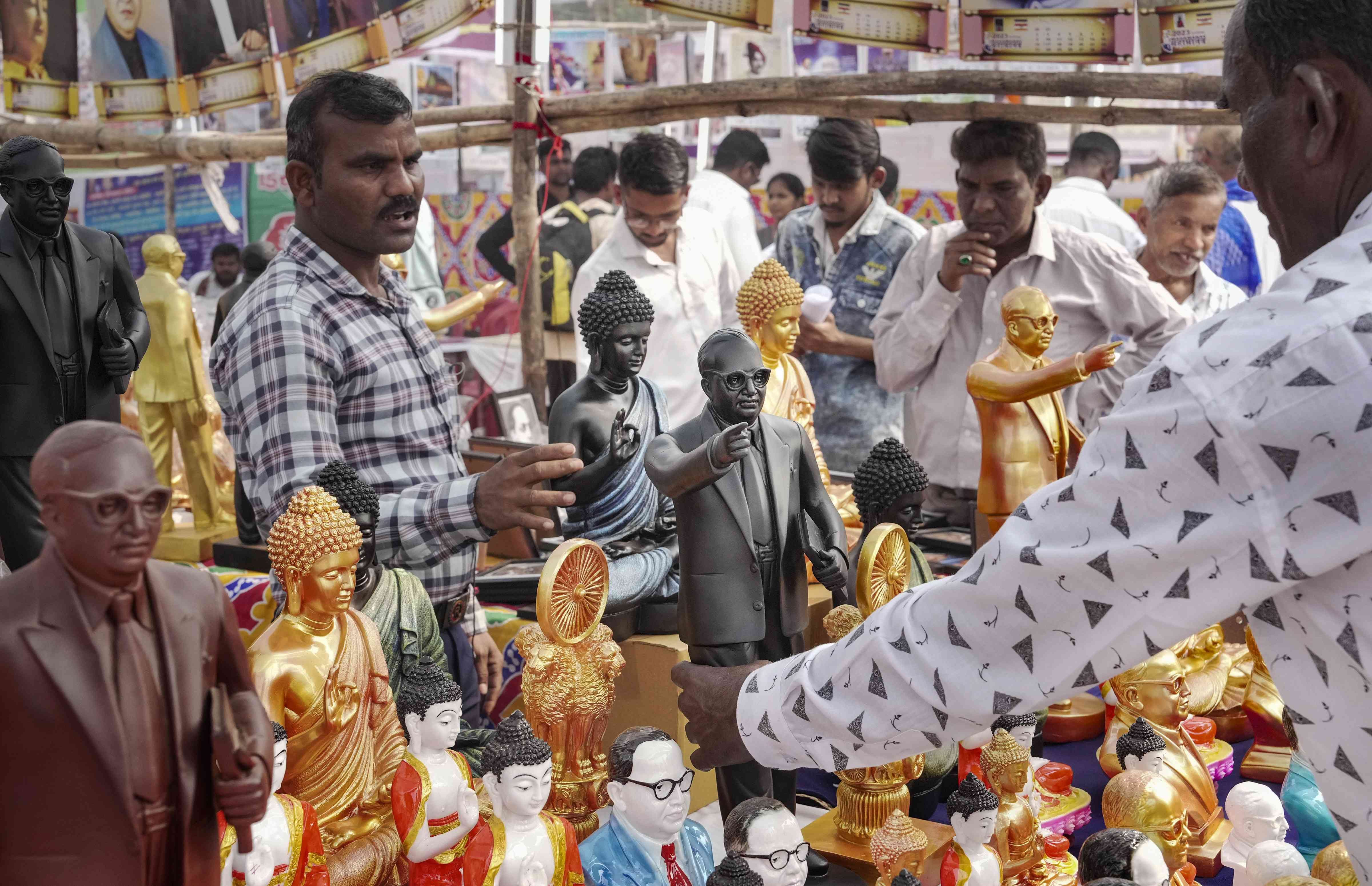
Image Credit: PTI
I had to read it twice. Then I had to sit with the sheer, unselfconscious irony of it, because that phrase does not belong to them. It belongs to Dr. B.R. Ambedkar. A Dalit, a man born into the Mahar caste that upper-caste India had spent centuries teaching itself to consider unclean, the chief architect of the Indian Constitution, and the single most consequential champion of caste equity this country has ever produced. It was his final call to the “depressed classes,” as the British colonial state called them, urging them to educate themselves out of ignorance, agitate against injustice, and organise for collective power. It is a phrase forged in the specific fire of anti-caste struggle. And here it was, borrowed wholesale: presumably without a flicker of self-awareness: by a movement built to dismantle the very policy Ambedkar spent his life fighting for.
It would be funny if it weren’t so telling. Because it captures exactly how much of the “anti-reservation” rhetoric in India is built on the erasure of the history it is standing on top of.
So let’s talk about that history.
Before the Constitution: Untouchability
Caste in India did not begin as a British administrative category, though colonial census-taking hardened and calcified it in ways that made mobility even harder. Its roots run into the varna system described in ancient texts, later elaborated into the jati system: thousands of hereditary, endogamous groups tied to occupation, ritual status, and, crucially, degrees of “purity” and “pollution.” At the bottom of this order, and technically outside the four-varna hierarchy altogether, were the communities who would come to be called “untouchables”: a designation that was not metaphorical. It meant that a shadow could pollute. That drinking from the same well could pollute. That entering a temple, a school, or sitting at the same table could pollute. Entire communities were pushed into occupations coded as ritually impure: manual scavenging, leatherwork, disposal of the dead: and then denied the right to leave those occupations, own land, or educate their children, precisely because of the stigma attached to the work society had trapped them in.
There are accounts from the Peshwa rule in modern-day Maharashtra describing how untouchables were prevented from using public streets due to the polluting effect of their shadow. In Poona, they were forced to wear a broom attached to their waist to sweep away their footprints. Visuals of such a humiliating practice have been immortalised by Dalit writers and poets: Dalit shahirs: performers in the late 19th and 20th centuries who created a body of literature and theatre known as Dalit jalse. Such ritual enforcement of segregation persists today in modernised forms of humiliation. This includes incidents where a 12-year-old Dalit boy died by suicide after being locked in a cowshed and shamed for accidentally entering an upper-caste house in Himachal Pradesh in October 2025, and the horrific case of a 14-year-old Dalit child forced to consume his own faeces in July 2020.
This was not a fringe practice. It was the operating architecture of large parts of Indian social life for centuries, enforced through violence, social boycott, and religious sanction. By the early twentieth century, as the Indian freedom movement gathered pace, the question of what to do about this architecture became impossible to avoid: and it produced one of the most consequential disagreements in Indian political history: between Mahatma Gandhi and B.R. Ambedkar.
Gandhi, Ambedkar, and the Poona Pact
In August 1932, the British government under Prime Minister Ramsay MacDonald announced the Communal Award, which granted separate electorates to several communities: Muslims, Sikhs, and, critically, the “Depressed Classes.” Ambedkar, who by then had already built the Depressed Classes Association and represented Dalit interests at the Round Table Conferences, supported it. A separate electorate meant Dalits could elect their own representatives, independent of caste-Hindu gatekeeping: real, structural political power, not power granted at the pleasure of upper-caste reformers.
Gandhi objected fiercely, believing separate electorates for Dalits would weaken the unity of the freedom struggle, and while imprisoned at Yerwada jail, he began a fast unto death on 20 September 1932 to force its withdrawal. This is worth sitting with plainly: Gandhi did not fast for Dalit rights. He fasted against a mechanism that Dalits themselves, led by Ambedkar, had asked for. He and Hindu leaders eventually pressured Ambedkar into an agreement that declined separate electorates but offered increased reserved representation for Dalits within the general Hindu electorate instead. Ambedkar, watching Gandhi’s life hang in the balance and under enormous political pressure, capitulated. The resulting Poona Pact, signed on 24 September 1932, allocated 148 reserved seats to the Depressed Classes in the legislatures: nearly double what the Communal Award had originally offered: but folded them back into a joint electorate, ending the possibility of independent Dalit political representation.
Ambedkar later described the affair in terms of coercion. A “fast unto death” is, after all, a form of moral blackmail few could resist without being blamed for a death. He got more seats. He did not get self-determination. It is documented negotiation under duress, and it laid the template for what “reservation” in India would come to mean: seats granted from above, inside a system still structurally controlled by the same castes that had spent centuries enforcing untouchability.
Ambedkar spent decades doing exactly what his own slogan demanded: educating himself relentlessly (he remains one of the most formally credentialled Indians in history, with degrees from Columbia and the London School of Economics), agitating through movements like the Mahad Satyagraha of 1927 for the right to draw water from public tanks, and organising politically: culminating in his role as Chairman of the Drafting Committee of the Indian Constitution, where he built reservation into the legal bedrock of the new republic as compensation for a documented, centuries-deep system of exclusion.
Reservation After Independence: And Its Very Deliberate Limits
The Constitution of India, adopted in 1950, provided reservation in government jobs and public education for Scheduled Castes and Scheduled Tribes, later extended to Other Backward Classes following the Mandal Commission recommendations implemented in 1990, and more recently to Economically Weaker Sections among the general category in 2019.
Here is the detail that gets lost in nearly every angry dinner-table argument about reservation: this system was only ever designed to apply to the state. Government jobs. Government-run and government-aided educational institutions. It was never extended, as a matter of course, to the private sector: and that omission has only grown more consequential with time.
It Was Never About Poverty
It is important to understand that reservation is not a poverty alleviation policy. It is a constitutional tool for social justice and representation. The Indian government has many poverty alleviation programmes like MGNREGA and Pradhan Mantri Awas Yojana. Caste-based reservation is meant to alleviate social injustice: which very much exists, and for which there is ample documented evidence.
This is where a lot of the anger misfires: the assumption that reservation exists to fix poverty, and that a wealthy Dalit taking a reserved seat is somehow “gaming” the system while a poor upper-caste candidate is being unfairly shut out. That assumption misunderstands what reservation was built to remedy in the first place.
Reservation for SC and ST communities was never means-tested, and that is not an oversight: it is the point. It exists to correct for social exclusion: the inherited, identity-based discrimination that attaches to a person’s caste regardless of what is in their bank account. Poverty alleviation is a separate policy question, and India does, in fact, have a separate income-based category for it: the Economically Weaker Sections quota introduced in 2019, which is explicitly restricted to the general category and capped by income and asset thresholds. The existence of EWS as its own distinct instrument is itself an admission, written into policy, that caste-based reservation was never meant to be a poverty index. It was meant to be a discrimination index.
And the research backs up why that distinction matters: money does not buy you out of caste. A landmark field experiment run by economists sending matched fictitious résumés to real job postings: identical qualifications, different caste-coded names: found that discriminatory screening occurred at the very first stage of hiring in private-sector India, before income, credentials, or class ever entered the picture. Separate research tracking income and wealth outcomes found that caste-based gaps shrink with higher education but do not close: Dalit, Adivasi, and OBC individuals with degrees still earn measurably less than upper-caste peers with the same qualifications, because the disparity is not produced by a skills gap but by ongoing discrimination in hiring, wages, and asset accumulation.
A wealthy Dalit doctor can still be told by colleagues that “people like her” do not belong in surgery. A landowning Dalit family can still be denied entry to a temple, barred from a shared well, or excluded from a housing society. Economic mobility changes a person’s bank balance. It does not, on its own, change how the people around them have been socially conditioned for generations to see their caste.
That is the piece that gets lost when people ask “why does a rich Dalit get reservation but I don’t?” The question assumes reservation is a wealth-transfer mechanism competing with other wealth-transfer mechanisms. It is not. It is a corrective for a form of exclusion that has never once checked anyone’s bank statement before deciding who gets to sit where.
Reservation Does Not Touch Most of India’s Jobs
Well over 90% of Indian employment now sits in the private sector, which carries no mandatory reservation policy at all. Meanwhile, the share of the workforce actually employed by the state has shrunk to a sliver. A government commission examining the issue found that government and public-sector employment together account for barely 2% of the country’s job market: a figure made starker by the fact that SC and ST communities together make up roughly a quarter of India’s population, yet are chasing a fraction of that already-shrinking 2%. Even the seats that formally exist go unfilled: more than 10 lakh central government posts were lying vacant as of 2023, a large share of them reserved posts, and more than 60 lakh vacancies exist across central and state governments and public sector undertakings combined. Liberalisation since the 1990s only accelerated this: as banking, telecom, airlines, and manufacturing shifted from public to private hands, the very jobs that reservation was built to open up simply stopped existing in the form the Constitution had addressed.
So when someone insists that reservation is “taking” a general-category person’s job, the more accurate framing is this: reservation governs access to a shrinking 2 to 10% of the Indian economy, while the vast, unregulated remainder operates on networks, legacy capital, and social access points that have historically: and still, disproportionately: run through upper-caste hands.
Education tells a nearly identical story. Reservation applies to government schools, government colleges, and centrally funded institutions like the IITs and IIMs: but a huge and growing share of Indian higher education now runs through private, unaided institutions with no such obligation, and even within the reserved public system, resources, faculty quality, and infrastructure are frequently inadequate to the scale of demand.
“Reservation Stole My Seat”
This is the argument you hear constantly from general-category aspirants who did not clear UPSC, NEET, or JEE: reservation took my seat. It is an understandable feeling in the moment of failure. It is also not what is actually happening.
Look at the actual numbers. On average, the UPSC Civil Services exam offers around 1,000 seats a year, drawn from roughly 11 lakh candidates who fill out the application form. In 2024, some 13.4 lakh candidates sat the Prelims alone, of whom only 14,627 qualified for the Mains, and a mere 2,845 advanced to interview stage. That is a success rate hovering around a few tenths of one percent: for everyone, general category included. NEET tells a similar story: nearly 24 lakh students appeared for NEET-UG 2024 for a fraction of that number of undergraduate medical seats nationwide. The bottleneck is not the reserved category. The bottleneck is that India, a country of 1.4 billion people, simply has not built enough seats, enough medical colleges, enough IITs, enough government posts to absorb the ambition of its own population. A general-category student who fails JEE is not losing to a Dalit or Adivasi classmate. They are losing to a system that has starved higher education and public employment of capacity for decades, then dangled the myth of pure “merit” as if lakhs of students were not all chasing the same few thousand doors.
This exact scarcity: this exact desperation: is also the soil in which India’s paper-leak epidemic grows. When the prize is that scarce and that life-defining, the incentive to cheat becomes enormous. The 2024 NEET-UG scandal, in which men later confessed to leaking the question paper the night before the exam and charging aspirants lakhs of rupees to memorise it in advance, triggered nationwide protests, with students at Delhi’s Jantar Mantar chanting “24 lakh students want exam, not scam.” 2024 alone also saw paper leaks and protests around the UPPSC RO/ARO exam and the CUET UG exam, part of a wider pattern of collapsing trust in India’s examination infrastructure. That collapse has nothing to do with reservation. It has everything to do with insane competition-to-seat ratios creating exactly the kind of high-stakes desperation that corruption exploits.
It is not a coincidence that the anti-reservation rhetoric has come back into public consciousness right at the fringes of a nationwide movement against NEET-UG paper leaks in 2026. The students of India feel starved and deprived. And they are. But reservation is not the enemy. The disastrous state of educational infrastructure is. As the title of this piece suggests, this grievance is misdirected: and it results from a lack of understanding of both the past and the present of the caste system.
The Violence Is Very Real
Caste discrimination in India still ends lives, routinely, in institutions that are supposed to represent meritocratic escape.
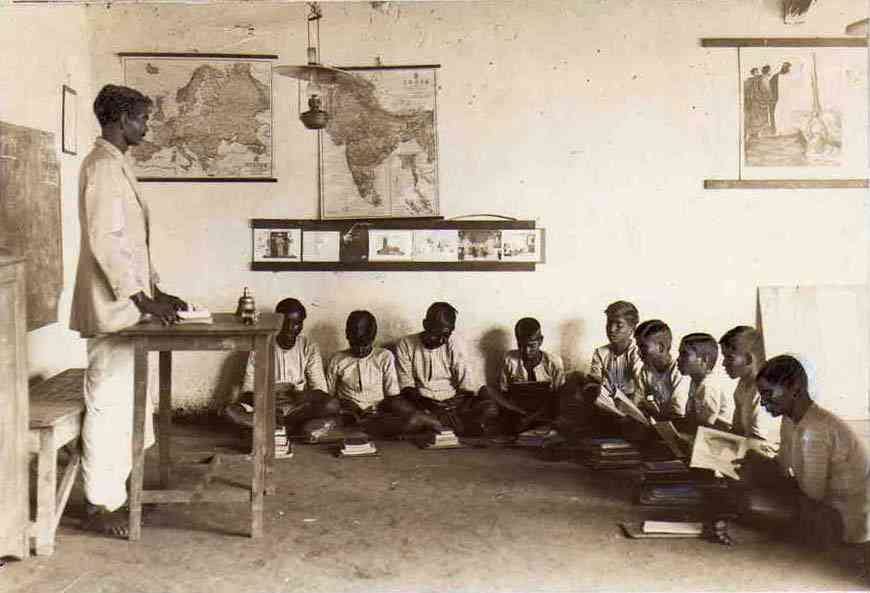
Image taken from Scroll.in. A teacher teaches a class of "untouchable" students in Hyderabad in the early 1900s. Image credit: In public domain via Wikimedia Commons.
Rohith Vemula. In January 2016, Rohith Vemula, a Dalit PhD scholar at the University of Hyderabad, died by suicide after he and four fellow students were suspended from the university, barred from common spaces, and evicted from their hostel over alleged “anti-national” politics linked to a clash between the Ambedkar Students’ Association and the ABVP. His death triggered protests across university campuses nationwide and became a rallying point for a new wave of Dalit student politics. It should be noted, in the interest of accuracy, that the case around his own caste status became disputed in the years since: a 2024 Telangana Police closure report claimed he was not in fact a Dalit and suggested his suicide was driven by fear of that discovery, a conclusion his family has disputed and sought to challenge in court. Whatever the final legal resolution, Vemula’s death forced a national reckoning with how caste operates inside elite Indian institutions, and it is impossible to discuss caste and higher education in India without it.
Payal Tadvi. In May 2019, Dr. Payal Tadvi, a 26-year-old second-year resident doctor from the Adivasi Tadvi Bhil community pursuing her postgraduate degree at BYL Nair Hospital in Mumbai, died by suicide after facing sustained harassment from three senior doctors. A chargesheet filed by Mumbai Police detailed months of casteist slurs and humiliation, including seniors telling her that “people like her could only be clerks,” and described her being deliberately kept away from important surgical duties. A Maharashtra government-appointed panel later found she had been ragged but stopped short of confirming caste-based harassment, even as an internal college investigation had already found evidence of “extreme harassment,” including casteist remarks: a familiar pattern in these cases, where official inquiries tend to soften what witnesses and chargesheets describe in stark detail.
The wider pattern. These are not isolated tragedies. Government data placed before the Lok Sabha showed 122 student suicides across IITs, NITs, IISc, IISERs, central universities, and other centrally funded institutions between 2014 and 2021: of which 58% were students from SC, ST, OBC, or minority backgrounds, despite those groups being a minority of the overall student body in most of these institutions. A 2023 Rajya Sabha response confirmed that 98 students from Dalit, Bahujan, and Adivasi communities died by suicide across central universities, IITs, NITs, IIMs, and IISERs between 2019 and 2021 alone. Student groups at IIT Bombay, Delhi, Kanpur, and Madras have told journalists that even these numbers understate the reality, since institutions frequently withhold details in official communications after a death, and some cases at IIT Madras were reportedly excluded from ministry tallies altogether. There have been innumerable cases of harassment and violence that have not ended in a Dalit student dying by suicide. That is somehow the better outcome. This is the machinery Ambedkar was trying to dismantle in 1932. It is still running.
What Discrimination Does to the Mind
There is a growing body of research documenting what decades of caste-based exclusion does to mental health: and it complicates the lazy administrative habit of writing off these deaths as purely personal or psychiatric in origin. Research on caste and structural inequality in Indian higher education has pointed out that Dalit students who die by suicide are frequently framed by institutional authorities as having had “personal problems” or depression: a framing that conveniently allows institutions to sidestep legal accountability for caste discrimination and violence. A 2025 study on Dalit students in Indian universities found that caste-based psychological suffering is deeply rooted in the social dynamics of caste itself, producing isolation and emotional distress that frequently develops into anxiety, depression, and self-harm: and that ideas of “merit” in Indian academic spaces often function as a disguise for caste privilege, turning success into a smooth pathway for the privileged while turning the same institutions into sites of humiliation and despair for Dalit students. Separate clinical research on caste-based trauma has found that chronic exposure to caste-based stigma measurably dysregulates the body’s stress-response systems, increasing long-term vulnerability to mental health disorders, while internalised stigma and social exclusion damage self-concept and psychological resilience: effects that can pass down across generations.
This is the piece that gets left out of “meritocracy” debates entirely: the playing field was never level to begin with, and the psychological toll of trying to survive on it while being told: explicitly: that you do not belong, that your admission was “only because of your caste,” that you can “only be a clerk,” is not incidental. It is cumulative, it is intergenerational, and it is, per the research above, a documented public mental health crisis in its own right.
Reservation was never a gift. It was compensation: however incomplete: for a system that spent centuries denying entire communities the right to own land, enter temples, draw water, sit in classrooms, or simply exist without being treated as dirty. It applies to a shrinking fraction of the Indian economy. It coexists with: and does not remotely offset: continued violence, humiliation, and death inside the very institutions it is supposed to open up. And it is being blamed, increasingly loudly, by people who have had the privilege of never having to calculate the cost of simply being born into the “wrong” community.
The people rolling their eyes at “quota kids,” organising Instagram pages to “hataofy” reservation, borrowing Ambedkar’s own words to dismantle Ambedkar’s own legacy: they are not fighting reservation’s excesses. They are fighting the bare minimum acknowledgment that hundreds of years of engineered exclusion do not undo themselves inside a single generation of token seats in a shrinking public sector.
Ambedkar knew this fight would not end with the Constitution. In one of his most enduring calls to the communities he spent his life representing, he said:
“My final words of advice to you are: educate, agitate and organise; have faith in yourself. With justice on our side, I do not see how we can lose our battle.”
That is the slogan the “Reservation Hatao Movement” borrowed for its Instagram bio. I hope, someday, they read the rest of the sentence.
- Rajrupa Bhattacharjee, Therapist, Feel Fuzzy
Looking for support?
This piece was written by Rajrupa Bhattacharjee, therapist at Feel Fuzzy. Rajrupa is a trauma-informed, relational, and queer-affirmative therapist with a social justice and intersectional lens. She works with identity, grief, relationships, and the psychological weight of navigating a world that is not always just.
If this piece has brought up anything for you, or if you are looking for a space to process what you are carrying, you can learn more about working with Rajrupa here.
References
-
Britannica. (n.d.). Poona Pact. Encyclopaedia Britannica.
-
Business Standard. (2024, September 16). Caste equality: Income disparity persists despite education, social capital.
-
Careers360. (2021, December 20). 58% student suicides in IITs, NITs, central institutions from SC, ST, OBC, minority communities.
-
Caste, mental health and self-harm: Emotive experiences of Dalit students at the Indian university. (2025). Journal of Contemporary African Studies.
-
The Clinical impact of caste-based trauma. (2025). International Journal of Interdisciplinary Approaches in Psychology, 3(7).
-
Constitution of India. (n.d.). Poona Pact 1932.
-
CPI(M). (n.d.). Resolution to extend reservations for SCs, STs and OBCs to the private sector.
-
CSEGuide. (2023, December 6). UPSC exam statistics on vacancies, number of candidates.
-
Deccan Herald. (n.d.). More than 60 lakh vacancies in Centre, state govts, PSUs: Commission.
-
Deccan Herald. (n.d.). Rohith Vemula suicide case: Family to challenge Telangana Police’s closure report.
-
Economic and Political Weekly. (2007, October 13). Caste and economic discrimination.
-
Global Ambedkarites. (n.d.). Importance of Dr Ambedkar’s formula “Educate Agitate Organise.”
-
Greater Kashmir. (2024, June 20). NEET UG 2024 paper leak scandal: Arrests, confessions and political fallout.
-
Kaushik, V. (2024, December 31). NEET fiasco, paper leaks: Student movements and exam controversies that rocked 2024. Careers360.
-
Komanapalli, V., & Rao, D. (2021). The mental health impact of caste and structural inequalities in higher education in India. Transcultural Psychiatry.
-
The Rationalist. (2025, May 12). Why India needs caste-based reservations in the private sector. Medium.
-
The Wire. (2025, September 25). Beyond statistics, the link between institutional caste discrimination and student suicides in India.
-
The Wire Science. (2019, June 11). Govt-appointed panel says Payal Tadvi was ragged, but no evidence of caste discrimination.
-
The Wire Science. (2019, July 25). Payal Tadvi case: Chargesheet reveals months of humiliation, discrimination.
-
Wikipedia. (n.d.). Poona Pact.
-
Wikipedia. (n.d.). Rohith Vemula.
-
Wikipedia. (n.d.). Suicide of Payal Tadvi.