

India's Students Are Not Just Angry. They Are Grieving.
Imagine this situation.
You are sitting at the dinner table with your parents. Or in your college canteen. Or in your office break room. Or scrolling through the WhatsApp family group.
And suddenly the people you have loved your entire life are saying something that makes your stomach turn.
They are dismissing what students have been going through. They are repeating things they have seen on television or in WhatsApp forwards without questioning them. They are telling you that “this is how the world works,” or asking why young people “can’t just focus on studying.”
You realise that things you thought were obvious may not be that way to others. Suddenly you are not arguing with strangers on the internet anymore. And your heart is no longer whole.
You look at them and wonder: how do we all live in the same country and experience completely different realities?
It Is Not Just About One Issue
For many young people today, the distress is about so much more than any single event. It is about what is happening inside their relationships.
One of the most common pieces of advice people hear during moments like these is: “Don’t let what’s happening in the world ruin your relationships.” It sounds reasonable. Mature, even. But the statement assumes that these issues exist separately from your life.
For many people, they do not.
If you are a student, exam integrity is not abstract. These examinations determine your future. If you have watched friends spend months or years preparing for competitive exams and then seen institutional failures put those efforts at risk, the current grief and frustration are not abstract. If you have watched young people gather in public spaces to demand accountability, only to come back injured, the question of whether the system sees you as someone whose pain matters is not abstract.
What you are experiencing may not be a difference of opinion. It may be a difference in values. And when values clash, relationships begin to feel unsafe in ways that are difficult to explain.
Moral Injury: A Name for What You Are Feeling
There is a term for this: moral injury.
It was first used to describe the emotional wounds soldiers experienced when they witnessed or participated in actions that violated their deepest moral beliefs. Today, psychologists use it more broadly to understand what happens when institutions, communities, or people we trust fail to act in ways that align with our sense of justice, humanity, or care. Research now recognises moral injury as a multidimensional phenomenon encompassing psychological, social and spiritual suffering, including guilt, shame, anger, and moral disorientation.
You do not have to be in a war to experience it.
Watching suffering be dismissed, watching cruelty be normalised, watching victims being blamed, watching student suicides treated as statistics: when these things feel fundamentally unjust to you, that is moral injury at work.
For many young people, the deepest wound is not simply “they disagree with me.” It is: “the people I love seem comfortable with something that violates everything I thought we believed about kindness, fairness, accountability, and compassion.” That is a very different kind of pain. And it deserves to be named as such.
What Has Been Happening
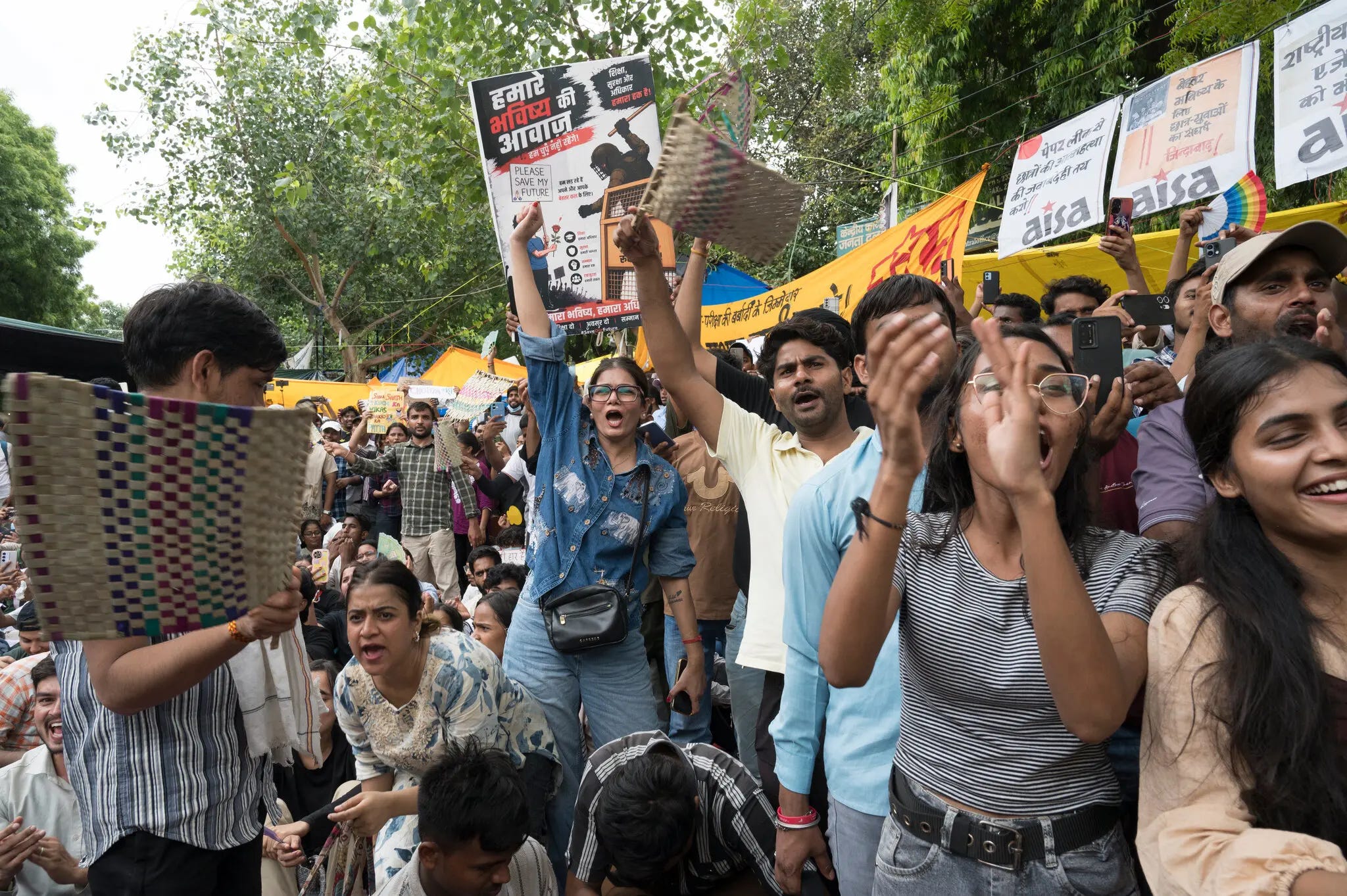
Image Credit: NY Times. Supporters of a student protest movement in New Delhi, India’s capital. Picture taken by Saumya Khandelwal for The New York Times.
In June 2026, what began as online frustration over the NEET paper leak became something much larger. The Cockroach Janta Party, a satirical youth movement formed after remarks in a Supreme Court hearing reportedly referred to unemployed youth disparagingly, became a vehicle for students to organise around a clear set of demands: accountability for the paper leak, structural reform of India’s examination system, and accountability for student deaths linked to exam-related stress.
The protests were joined by activist Sonam Wangchuk, who began an indefinite hunger strike at Jantar Mantar on June 28. Thousands gathered. The movement gathered national attention.
On July 20, during the opening day of Parliament’s Monsoon Session, students organised a “Chalo Sansad” march to make their voices heard. Eyewitness accounts, journalists, and medical staff at Ram Manohar Lohia Hospital described students returning with injuries. The events of that day are still contested, but what is not contested is that students came out peacefully to ask for accountability, and many left hurt.
In the days that followed, the Education Minister resigned, acknowledging accountability for the crisis. The government indicated it was considering compensation for families of students who died by suicide in connection with the exam crisis.
For students who have been carrying this for weeks and months, the question of what they feel now, whether it is relief, grief, exhaustion, or something harder to name, deserves space.
The Emotional Weight of Feeling Unsupported
When students feel that the institutions meant to serve them have failed them, the psychological impact goes far beyond stress. Research on moral injury shows that the experience of being let down by systems you were supposed to be able to trust produces a specific kind of wound: one that does not just feel bad but fundamentally shifts how safe the world feels.
Moral injury encompasses not just individual psychological suffering but relational and social suffering too, including a damaged sense of trust between people and the institutions they depend on. When you have given years of your life to a process and that process is compromised, the question that follows is not just “what do I do now?” It is: “did any of it matter? Does anyone in power actually see me?”
That question, left unanswered, is not just demoralising. It is destabilising. And it does not stay in one corner of a person’s life. It bleeds into how they relate to the people around them, including the people they love.
Why Epistemic Trust Breaks Down
As children, we build our understanding of the world by trusting other people. Psychologists call this epistemic trust: our ability to rely on people and institutions to help us understand reality.
Parents tell us the stove is hot. Teachers explain history. Journalists report what happened. We cannot personally verify everything, so our brains constantly ask: who can I trust to help me make sense of the world?
During moments of widespread misinformation and competing narratives, that trust begins to fracture. Research confirms that exposure to misinformation is associated with declining trust in media, politics and science, and increasing polarisation. Suddenly your parents trust one source of information while you trust another. Your professor says one thing. Your friends who were physically present describe something completely different.
The distress is not really about the content of the disagreement. It is about realising that the people you have always relied on to interpret reality no longer seem to occupy the same reality as you. And when that happens inside your own home, the loneliness of it is profound.
Why Evidence Often Is Not Enough
One of the hardest lessons to accept is that evidence alone rarely changes minds. Research on cognitive dissonance shows that when people are confronted with information that contradicts their existing beliefs, they experience psychological discomfort and tend to seek out information that reinforces what they already believe, rather than revising their worldview.
Imagine believing for years that a particular institution or system fundamentally protects people. Now imagine being presented with evidence that challenges that belief. The discomfort can be enormous. Some people respond with curiosity. Others reject the new information altogether because changing their worldview feels more threatening than defending the old one.
This is why even well-educated people who consider themselves rational and critical thinkers can fall into misinformation traps. It is not about intelligence. It is about the psychological cost of dismantling a belief that has become part of how someone understands themselves and their world.
Understanding this does not excuse dismissing real suffering. But it does explain why arguing harder often does not work, and why the grief of not being heard by someone you love runs so deep.
The Emotions Underneath the Anger
Many people describe feeling angry during moments like these. But underneath the anger are several quieter emotions.
Grief for the future they imagined. Fear about what comes next. Disappointment in people they once trusted. Loneliness. Powerlessness. Confusion. Betrayal. Guilt.
Anger often becomes the emotion we express because it is easier. It is easier than saying: “I am heartbroken that I do not recognise the people I love anymore.” Or: “I am scared that the way you speak about people who are suffering is what you truly think about suffering in general.” Or: “I feel alone in a home full of people.”
The underlying grief is rarely expressed. It is just felt.
This grief is particularly hard to explain because you may feel like you are mourning people who are still alive. Psychologists describe this as ambiguous loss: the grief we experience when someone is still physically present but the relationship feels fundamentally different, as though something has shifted that cannot easily shift back. Ambiguous losses are among the hardest we experience precisely because there is no socially recognised ritual for grieving them. No clear ending. No acknowledged loss. Just a quiet, persistent ache.
Three Kinds of Relationships
Some relationships will recover after moments like these. Others will not. Because moments of crisis reveal values that were always there.
Growing up sometimes means discovering that the people who taught us our values will not always live by them in the ways we hoped.
One of the hardest skills adulthood asks of us is learning to distinguish between three different kinds of relationships.
There are people who disagree with you but remain curious. There are people who disagree with you and are willing to hear your perspective. And there are people who are committed to misunderstanding you.
These relationships require different responses. Curiosity deserves conversation. Respect deserves reciprocity. But contempt rarely transforms through debate. Protecting yourself from repeated contempt is not giving up. It is recognising where your emotional energy has the greatest chance of creating genuine connection.
When Walking Away Is Not an Option
This advice becomes much more complicated if you are financially dependent on your parents, living in the same home or hostel, sharing classrooms, or working alongside the people you are in conflict with.
When you are navigating relationships with unequal power, walking away is not always available. Neither is speaking up every single time. Many young people are constantly calculating invisible risks around safety, income, grades, housing, and mental peace.
Sometimes preserving your safety has to take priority over expressing every opinion.
Setting limits becomes necessary. We often imagine this as cutting people off or blocking them entirely. But limits can also look much quieter: choosing not to discuss certain topics, changing the subject, leaving a room, ending a phone call, or simply deciding not to engage when you know the conversation will leave you emotionally depleted.
Limits are about deciding what you are willing to repeatedly expose yourself to. Not controlling other people’s behaviour, even when you know they are wrong.
The Body Is Living Through This Too
One of the most psychologically protective things you can do during periods of collective difficulty is to find community: spaces where your emotional reality is recognised. Close friends, a student collective, a therapist, a trusted professor, an online community, anyone who can witness the pain you are carrying. Validation does not solve systemic crises. But it reminds your nervous system that you are not carrying them alone.
Because your nervous system is living through this too. If you have found yourself doomscrolling until 2 a.m., crying unexpectedly, feeling exhausted after family dinners, replaying arguments in your head, or feeling guilty every time you step away from the news: your body is responding to prolonged stress in exactly the way bodies do.
Our brains are not designed to remain in a constant state of vigilance. When we repeatedly encounter emotionally overwhelming stories, conversations, and uncertainty, our bodies begin preparing for danger even when that danger is not physically in front of us. Some people become hypervigilant, constantly checking for updates. Others become emotionally numb. Some become irritable. Others feel exhausted by caring so much.
Taking breaks is not abandoning the cause. It is giving your nervous system enough space to continue caring.
You Are Allowed to Feel All of This
Healing begins by acknowledging that your emotional response makes sense in the context of what you have lived through.
But you do not have to start healing until you are ready. You can feel all of your emotions and allow yourself to keep grieving.
Because grief is not weakness. It is what love looks like when the world changes faster than our relationships know how to.
And if you are a student who has been carrying the weight of this moment, your hard work was real. Your preparation was real. Your exhaustion is real. And your pain deserves care, not just resilience.
- Tanisha Goveas (she/they), Therapist, Feel Fuzzy
You Don’t Have to Carry This Alone
Feel Fuzzy believes that words without action are not enough. That is why we are launching the Feel Fuzzy Student Therapy Programme: heavily discounted therapy slots specifically for students, because mental health support should not be another thing that is only available to those who can afford it.
If you are a student navigating the weight of this moment, whether it is grief, exhaustion, relationship conflict, or simply the need for a space where someone actually listens: we are here.
Learn more and sign up for the Feel Fuzzy Student Therapy Programme here.
References
-
Litz, B.T., et al. (2009). Moral injury and moral repair in war veterans: A preliminary model and intervention strategy. Clinical Psychology Review, 29(8), 695-706.
-
Molendijk, T. (2025). Addressing moral injury in practice: Suggestions for organisational, political and societal interventions. European Journal of Psychotraumatology.
-
Psychology Today (2024). Moral injury meets politics.
-
Festinger, L. (1957). A Theory of Cognitive Dissonance. Stanford University Press.
-
Frontiers in Social Psychology (2025). The psychological cycle of misinformation: An integrative model of legitimation perception in social networks.
-
Advances in Psychology (2026). The psychology of misinformation: An evidence-based guide.
-
ScienceDirect (2025). Knowledge types and cognitive processing modes associated with online news credibility assessment.
-
Boss, P. (1999). Ambiguous Loss: Learning to Live with Unresolved Grief. Harvard University Press.
-
Business Today (2026). CJP protest timeline: The student movement that led to the Education Minister’s resignation.
-
Al Jazeera (2026). Indian student protests: What’s next after the government’s promise on exam leaks?