

The Well-Being of India’s Students Is Not a Left or Right Issue
Whether you are left-wing, right-wing, or somewhere in between, supporting the students of this country so that their years of hard work are not wasted, so that the systems meant to serve them actually do: that is not a partisan position. It is a basic one. Demanding accountability from those in power is a democratic right. It is, in fact, patriotic.
And right now, India’s students need to be seen.
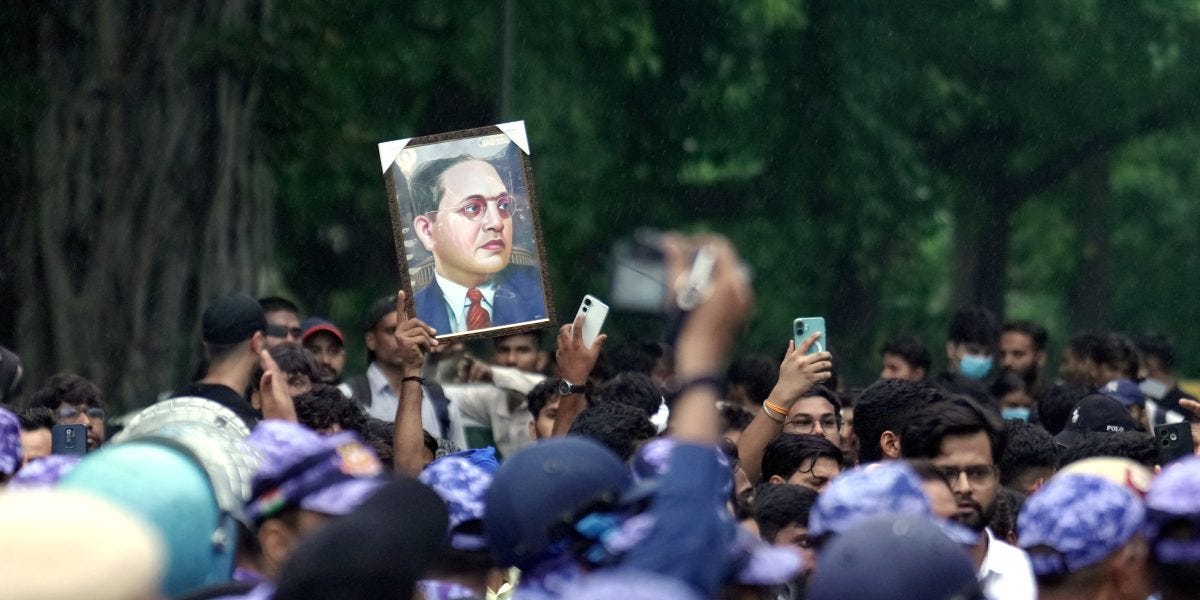
Image taken from The Wire. Protesters hold a portrait of Dr Bhim Rao Ambedkar, near Jantar Mantar ahead of a protest march, in New Delhi, early Monday, July 20, 2026. Photo: PTI.
What Happened: and What It Cost
On May 3, 2026, over 22 lakh students sat the NEET-UG. One week later, it was cancelled. Over 120 questions had leaked via WhatsApp before the exam, first discovered in Sikar, Rajasthan. For the students who had spent years preparing for that one day, the cancellation did not feel like a procedural decision. It felt like everything they had worked for had been taken from them.
This was not the first time. In 2024, a paper leak in Bihar triggered nationwide protests and a CBI probe. Allegations emerged of solved papers being sold for Rs. 30-50 lakh. Scores of 718 and 719 out of 720 surfaced: mathematically impossible under the NEET marking scheme: raising serious questions about the integrity of results. The Supreme Court scrapped grace marks awarded to over 1,500 students and ordered a re-test. Between NEET, CUET, UGC-NET, and state-level examinations, 2024 became a year marked by one exam controversy after another.
The pattern is not new. But the toll it is taking is.
The Mental Health Cost No One Is Counting
Mental health does not arise in a vacuum. It is not purely internal, purely individual, purely a matter of coping strategies and mindset. It is shaped by the environment people live in, the systems they depend on, and what those systems communicate about their worth.
According to the National Crime Records Bureau, over 13,089 students died by suicide in India in 2021 alone, a rise of 70% over the previous decade. Exam failure and academic pressure are among the leading identified factors.
Nowhere is this more visible than in Kota, Rajasthan, where over two lakh students arrive every year from across the country to prepare for JEE and NEET. A study published in the Annals of the National Academy of Medical Sciences found that most student suicides in Kota occurred on days when fortnightly exam results were announced. 32 suicides were officially recorded among coaching students in Kota in 2023 alone. A 2023 study found that over 85% of students in Kota spend six to seven hours daily in coaching classes, with many logging twelve-hour days, far from home, in environments with little room for rest, leisure, or emotional support.
These are not statistics about weak students. They are statistics about a system that has placed an extraordinary and often unsustainable burden on young people, and then provided almost nothing to catch them when they fall.
Who Really Bears the Cost
When we talk about a paper leak, it is easy to treat it as an abstract institutional failure. But the cost lands very specifically on very real people: and it does not land equally.
For young women from families where education is already a contested space, a cancelled exam is not a postponement. It is often a door closing. Analysis of the 2026 NEET crisis found that first-generation women aspirants face unique social pressure when examinations are delayed or cancelled, as the window for academic pursuits narrows under family pressure to marry. For a girl who has spent two or three years preparing, whose family allowed her that time on the condition that she succeed, a cancelled exam can become the justification for “enough is enough.” The question is no longer when she will become a doctor. It becomes whether she will be allowed to try again at all.
For students from poor, working class, and farming families, the stakes are not just personal. They are financial. Pradeep Manich, a 23-year-old aspirant from Jhunjhunu, Rajasthan, died by suicide days after the 2026 cancellation. His father was a labourer. His family had sold land and taken on debt to fund his coaching and accommodation in Sikar. He is not an isolated story. Across India, families from modest backgrounds take loans, sell assets, and go without so that one child can have the chance at a government medical seat, which is often the only financially viable path to medicine. When that exam is cancelled: and when another year of coaching fees, rent, and living expenses looms: the burden does not just fall on the student. It falls on an entire household that has already given everything.
For students from marginalised communities: Dalit, Adivasi, and OBC students, students from rural areas, students who are the first in their families to make it this far: a NEET cancellation is not simply a setback. It is a compounding of every disadvantage they were already navigating. They often have fewer attempts at life’s disruptions than their more privileged peers. A cancelled exam year does not mean taking a gap year in a comfortable home. It can mean a complete derailment, because the family circumstances, the financial pressure, and the social weight that made this exam so hard to reach in the first place do not pause while the system sorts itself out. These students do not have the luxury of indefinite attempts.
What a paper leak reveals, when you look at who suffers most, is not just a failure of exam security. It is a failure of equity. A single high-stakes exam, with no robust fallback, in a deeply unequal country, will always punish the most vulnerable the hardest when it fails.
What a Paper Leak Does to a Student
The NEET-UG cancellation this year is not just a logistical problem. Mental health experts have warned that exam controversies of this scale increase the risk of suicide attempts, severe anxiety, clinical depression, and a profound and lasting sense of hopelessness among aspirants.
Consider what a NEET aspirant’s preparation actually looks like. Many leave their hometowns in their mid-teens. They move to cities like Kota or Sikar, away from family and friends. They put hobbies, social lives, and their own mental health on hold. They study for two, sometimes three years. They sit in rooms for ten to twelve hours a day. They sacrifice a significant portion of their adolescence for a single three-hour exam.
When that exam is compromised, it is not just an inconvenience. It is a message. It says: the system you trusted did not protect you. The effort you made was not enough to guarantee fairness. The future you were working toward is, once again, uncertain.
Students protesting after the 2026 cancellation described “shattered dreams” and asked who would answer for the sleepless nights. That question deserves an answer.
Demanding Better Is Not Overreacting
There is sometimes a tendency to tell students to be resilient. To focus on what they can control. To not let external events derail them. And while individual coping tools matter, placing the entire burden of this crisis on students themselves is not only unfair. It misses the point.
Resilience is not the same as endurance. A student who has spent three years preparing for a compromised exam, who is watching their peers protest in the streets, who does not know when they will get a fair opportunity to sit the exam again: that student is not failing to cope. They are responding rationally to a genuinely difficult situation.
Holding institutions accountable for exam integrity, demanding transparency in how papers are stored and distributed, asking for mental health support to be built into the examination ecosystem rather than treated as an afterthought: these are not unreasonable demands. They are the minimum that students deserve.
The Alleged Violence on July 20
Yesterday, students came out in their thousands to make their voices heard. And what they were met with demands to be acknowledged.
On July 20, 2026, over 10,000 students and supporters gathered at Jantar Mantar in Delhi for a march toward Parliament, demanding accountability over the exam integrity crisis. Volunteers moved through the crowd distributing food and water. Organisers repeatedly asked demonstrators to remain peaceful.
What followed has been described by eyewitnesses, journalists, and others as deeply troubling. Students at the emergency ward of Ram Manohar Lohia Hospital that evening presented with bloodied bandages, stitched wounds, and bruised and swollen limbs. Protesters alleged they were met with lathi charges and tear gas as they attempted to march beyond the protest site. Allegations have also emerged of pellet guns being used, and of female protesters being beaten up by officers.
Delhi Police have stated that protesters “resorted to large-scale violence” and vandalised public property. Those claims and the claims of the protesters are contested, and the full picture is still emerging. What is not contested is that students came out to demand accountability for a system that failed them, and that many of them left injured.
This is not normal. This should not be normal.
Whatever one believes about the specifics of what happened on July 20, the images coming out of Delhi yesterday are a stark reminder of something important: these are students. They are young people who sat entrance exams that were compromised, who lost years of preparation to a failure that was not theirs, and who came out to ask for something as basic as a fair system. They were not asking for the impossible. They were asking for what every student in this country deserves.
Questioning those in power is a democratic right. Demanding better is patriotic. And meeting peaceful student protesters with force is not a response to a crisis. It is an escalation of one.
We Stand With You
Mental health does not exist in a silo. It is built and broken by the world around us. When students feel unsupported, when they feel that their hard work has been rendered meaningless by failures that were not theirs, when they feel a lack of accountability from the institutions that were supposed to serve them: that creates a genuine, measurable impact on mental health. It is not just stress. It is grief. It is anger. It is a rational response to injustice.
As a mental health platform, Feel Fuzzy stands with the students of India. Not because it is politically convenient, but because it is the only honest position to hold. Any person, from any part of the political spectrum, who cares about the future of this country should be asking the same question: what do we owe the young people who are carrying it?
They deserve fair examinations. They deserve accountability when systems fail. They deserve mental health support that is built into the system, not bolted on as an afterthought. And they deserve to be told, clearly and without qualification, that their hard work matters.
If you are a student navigating the weight of this moment and you need someone to talk to, we are here.
Explore Feel Fuzzy’s therapists here. If cost is a barrier, we also offer sliding scale and pro-bono sessions.
Feel Fuzzy believes that words without action are not enough. We are committed to doing our part. We will soon be launching the Feel Fuzzy Student Therapy Programme specifically for students. Stay tuned.
- The Feel Fuzzy Team
References
-
CMHLP (2026). NEET 2026 paper leak: Impact on student mental health.
-
Outlook India (2026). Beyond the paper leak: Emotional trauma among NEET aspirants raises concern.
-
Annals of National Academy of Medical Sciences (2024). Kota suicides for NEET: A problem demanding urgent attention.
-
Value in Health (2024). Kota: The emerging suicide city of India.
-
The Diplomat (2024). Student suicides in Kota’s coaching factories point to India’s broken education system.
-
Hindus for Human Rights (2026). The NEET paper leak: Student rights, NTA failure, and exam reform.
-
Kartavya Sadhana (2026). NEET-ReNEET-Repeat: The cost of repeated exam failures.
-
Outlook India (2026). Broken bones, bruises and stitches: Scores injured as lathi-charge, tear gas mark CJP’s march to Parliament.
-
Al Jazeera (2026). ‘Now or never’: Students defy Delhi lockdown to march on India’s Parliament.
-
Scroll.in (2026). CJP updates: Opposition demands Parliament discussion about police lathi-charge on protesters.
-
Drishti IAS (2026). NEET-UG 2026 paper leak: Crisis in India’s examination system.
-
Outlook India (2026). NEET-UG 2026 paper leak scandal: Collapse of trust, student suicides and India’s medical entrance crisis.